
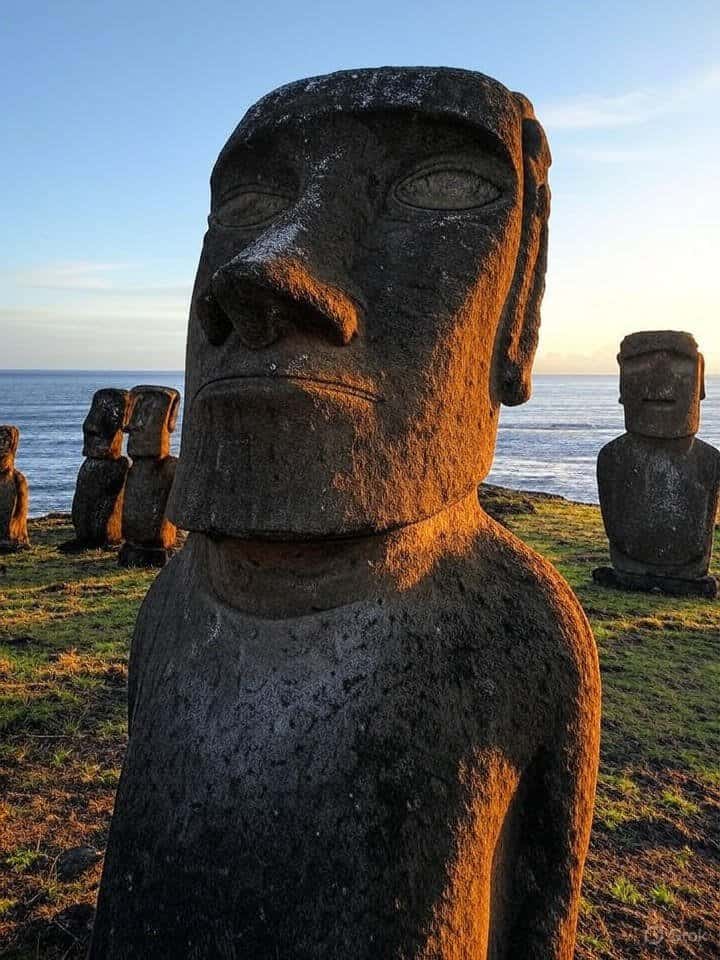
The Enigmatic Journey of the Moai
Easter Island’s colossal moai statues, those stoic sentinels crafted 800 years ago, have long baffled scientists and thrill-seekers alike. How did a civilization, armed only with Stone Age tech, manage to sculpt and transport these behemoths, some tipping the scales at a whopping 92 tons? Archaeologist Carl Lipo from Binghamton University proposes a theory straight out of a sci-fi novel: these giants didn’t just stand there; they ‘walked’ to their ahu platforms, guided by the deft hands and ropes of the Rapa Nui people. This isn’t just a wild guess; it’s rooted in the island’s oral traditions, where songs speak of ancestors making the statues stride across the landscape.
Imagine a scene from a dystopian thriller: workers, with ropes in hand, coaxing a towering moai to move with a rocking motion, like a giant puppet in a macabre parade. Lipo’s hypothesis isn’t just for show; it’s backed by gritty field tests and cutting-edge 3D modeling. In a world where every theory must face the tribunal of skepticism, Lipo’s latest paper in the Journal of Archaeological Science throws down the gauntlet with fresh evidence, daring critics to debunk the walking moai once and for all.
From Quarry to Platform: A Feat of Ingenuity
The first Europeans to stumble upon Easter Island in the 17th century found a mere few thousand inhabitants on this remote speck of land, 14 by 7 miles, adrift in the vast Pacific. Yet, the island was littered with moai, suggesting a once-thriving civilization. Lipo, ever the contrarian, posits that perhaps the islanders didn’t need a bustling metropolis to move these statues. In a 2012 experiment that could have been ripped from a survivalist’s playbook, Lipo and Terry Hunt from the University of Arizona demonstrated that a 10-foot, 5-ton moai could be transported hundreds of yards with just 18 people and three sturdy ropes, employing a rocking motion that made the statue seem to ‘walk’.
But the moai weren’t the only puzzle. Some of these statues sported hefty red hats, weighing up to 13 tons. How did they get there? Lipo’s 2018 theory sounds like a plot twist in a sci-fi saga: the islanders rolled these hats up ramps using ropes, a method as simple as it is ingenious. It’s a testament to human ingenuity, or perhaps a hint at an ancient, forgotten technology. The islanders’ choice of statue locations, Lipo’s team later deduced, was no random act but a calculated decision based on proximity to fresh water sources, as detailed in a 2019 paper in PLOS One.
Challenging Conventional Wisdom
Lipo’s theories aren’t just about moving statues; they challenge the very fabric of our understanding of Easter Island’s past. The notion that a small group could achieve such monumental feats without the need for a large workforce turns traditional archaeology on its head. It’s as if Lipo is suggesting that the islanders were not just builders but masterminds of efficiency, using the physics of motion and the island’s resources in ways that modern minds are only beginning to grasp.
The skepticism surrounding the ‘walking’ moai hypothesis is as thick as the fog that often shrouds the island. Yet, Lipo’s relentless pursuit of truth, armed with 3D models and field tests, paints a picture of a civilization not just surviving but thriving through ingenuity and sheer willpower. It’s a narrative that could inspire a new generation of archaeologists to rethink what’s possible with limited resources and boundless creativity.
Scientific Facts Worth Knowing
- •💡 Easter Island’s moai statues, some weighing up to 92 tons, were constructed around 800 years ago.
- •💡 Archaeologist Carl Lipo and his team demonstrated that a 10-foot, 5-ton moai could be moved with just 18 people using a rocking motion.
- •💡 Lipo’s 2018 hypothesis suggests that the red hats on some moai, weighing up to 13 tons, were rolled up ramps using ropes.
- •💡 Quantitative spatial modeling indicated that moai locations were chosen based on proximity to fresh water sources, as published in PLOS One in 2019.
- •💡 The ‘walking’ moai theory challenges the assumption that Easter Island once had a population in the tens of thousands, suggesting fewer people could have accomplished the feat.