
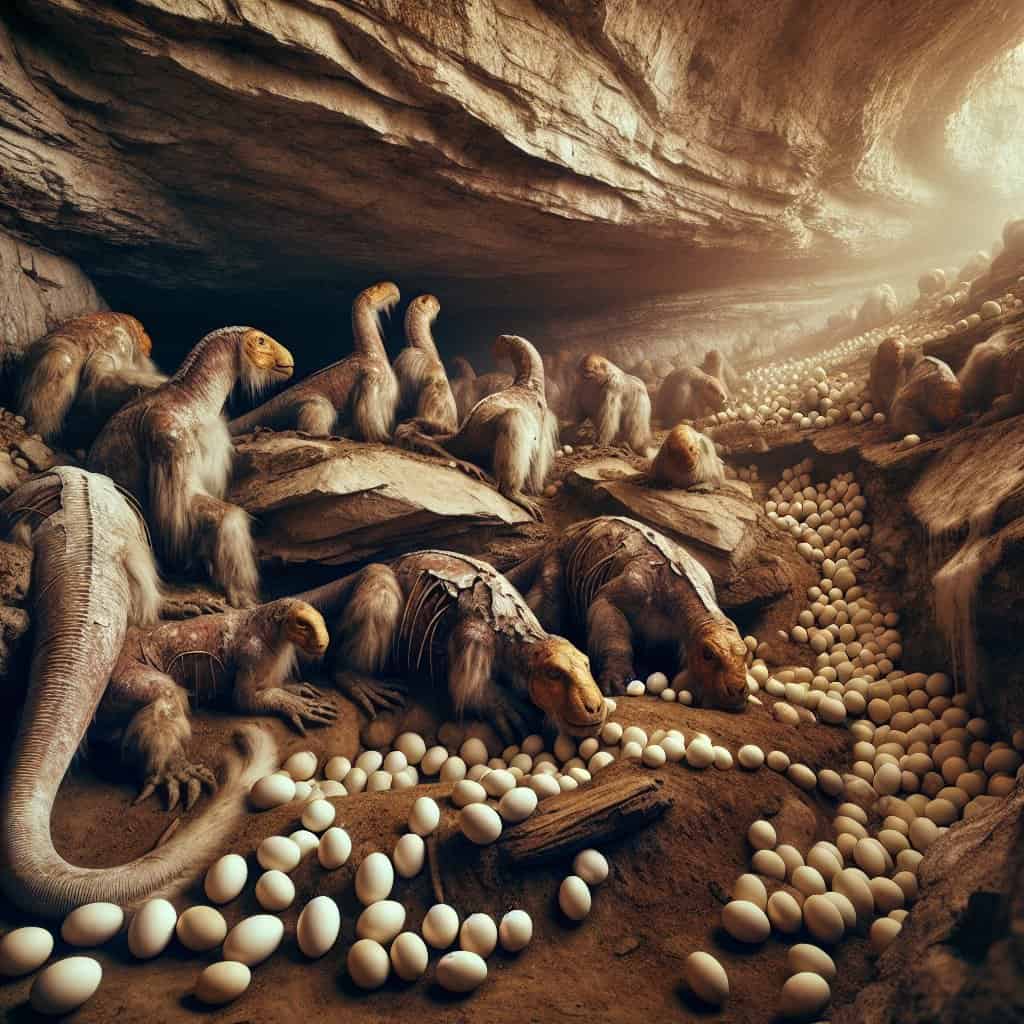
Eggs in the Age of Dinosaurs
In a plot twist worthy of a sci-fi thriller, a 250-million-year-old fossil has finally confirmed that our mammalian ancestors, like the Lystrosaurus, were indeed egg layers. This revelation comes courtesy of an international team of researchers who unearthed a fossilized egg containing a Lystrosaurus embryo. This tough, plant-eating creature not only survived the End-Permian Mass Extinction, which obliterated most life on Earth, but thrived in its wake. Imagine an apocalypse where only the hardiest survive, and Lystrosaurus was the ultimate doomsday prepper.
The discovery, published in PLOS ONE, is the first of its kind, proving that early mammal ancestors laid eggs. Led by Professor Julien Benoit and his team, this finding answers a question that has puzzled scientists for eons: Did our furry forebears lay eggs? The answer, as it turns out, is a resounding yes. This discovery is not just about eggs; it’s a window into the survival strategies that allowed these creatures to flourish in a world gone mad.
The Elusive Soft-Shelled Enigma
Why have these ancient eggs been so elusive, you ask? The answer lies in their soft-shelled nature. Unlike the hard, fossil-friendly eggs of dinosaurs, these delicate eggs were more prone to decay before they could fossilize. John Nyaphuli, a fossil detective extraordinaire, first spotted the nodule that would later reveal the Lystrosaurus embryo. It was a moment of serendipity, akin to finding a needle in a haystack, or in this case, a hatchling in a nodule.
Professor Jennifer Botha recalls the painstaking process of preparing the specimen, which at first seemed like a few flecks of bone. But as the fossil was carefully unearthed, it became clear they had stumbled upon something extraordinary. Fast forward to the present, and with the help of modern synchrotron x-ray CT scanning, the team was able to peer inside the fossil and confirm their suspicions. This high-tech peek into the past provided a level of detail that was once the stuff of science fiction.
Big Eggs, Big Advantages
Lystrosaurus was no ordinary survivor. It produced relatively large eggs, a clever adaptation that allowed its young to develop independently, sans parental care. This strategy was a game-changer in the post-apocalyptic landscape of the End-Permian era. Large eggs meant more yolk, and more yolk meant a better chance of survival in a world where milk was not on the menu.
The hefty eggs also had the added benefit of being more resistant to desiccation, a crucial trait in the arid, unpredictable climate that followed the mass extinction. The hatchlings, likely precocial, were born ready to face the world, feeding themselves and dodging predators with the agility of a seasoned action hero. In essence, Lystrosaurus had cracked the code to thriving in a harsh environment: grow fast, reproduce early, and let your offspring fend for themselves.
Survival of the Egg-Layers
In the grand scheme of evolution, Lystrosaurus’ egg-laying strategy was a masterstroke. It combined adaptability, resilience, and reproductive savvy to become a dominant force in the post-extinction ecosystem. As scientists continue to unravel the mysteries of ancient life, it’s clear that survival in extreme conditions hinges on these very traits.
Julien Benoit eloquently sums it up: the discovery not only answers a long-standing question about mammalian reproduction but also provides insights into how species can adapt to rapid environmental changes. In a world increasingly threatened by climate change, these ancient lessons are more relevant than ever. As we peer into the past, we find clues that could help us navigate our uncertain future. And, much like a well-crafted sci-fi epic, this research leaves us with more questions than answers, fueling the quest for knowledge in the ever-evolving saga of life on Earth.
Scientific Facts Worth Knowing
- •💡 Lystrosaurus thrived post-End-Permian Extinction, a period when most life perished.
- •💡 The fossilized egg discovery is the first confirmed egg from a mammal ancestor.
- •💡 Modern synchrotron x-ray CT scanning revealed the embryo’s developmental stage.
- •💡 The study suggests Lystrosaurus laid large, yolk-rich eggs for independent offspring.
- •💡 These findings offer insights into species resilience amid rapid climate changes.