
An Unprecedented Cosmic Flare
In March, the cosmos gifted us with a spectacle unlike any other: the brightest fast radio burst (FRB) ever recorded. This ultrabright flash, originating a mere 130 million light-years from Earth—a cosmic stone’s throw—shattered previous records. Its proximity allowed unprecedented investigation, providing a tantalizing glimpse into the enigmatic nature of these millisecond-long bursts of radio waves. This event, christened RBFLOAT (a nod to a certain root beer-related inside joke), is rewriting the textbooks on these powerful cosmic phenomena. It’s like finding a hyper-bright supernova in your backyard. Unexpected, to say the least.
This extraordinary event, detailed in two papers published in the August 20 Astrophysical Journal Letters, challenges our current understanding of FRBs. These bursts, first detected in 2007, typically release the energy equivalent of the sun’s output over several days, compressed into milliseconds. With approximately 4,000 unique FRBs detected to date, largely thanks to the CHIME telescope array, RBFLOAT stands out as an anomaly. Its sheer brightness, roughly double that of the previous record holder, suggests something truly exceptional is at play. It’s as if the universe decided to stage a particularly loud fireworks display just for us.
Unraveling the Mystery of RBFLOAT
While RBFLOAT’s intrinsic energy was surprisingly ‘average,’ its brightness betrayed its proximity. The inverse-square law of light intensity tells us that the closer the source, the brighter it appears. This proximity allowed researchers, using CHIME’s auxiliary telescopes spanning British Columbia, West Virginia, and California, to pinpoint its origin to a galaxy in Ursa Major. It was like finding a needle in a cosmic haystack, except the needle was incredibly bright and emitting radio waves.
The burst’s location within a young star-forming region, combined with infrared signals detected by the James Webb Space Telescope, further deepened the mystery. This multi-wavelength observation is unprecedented in FRB research. We’ve never had such a detailed view of the environment surrounding an FRB before. This level of detail opens up a whole new avenue of investigation, allowing scientists to test existing theories with unprecedented precision. It’s science fiction become reality.
Magnetars: The Prime Suspects?
The leading hypothesis points towards magnetars—highly magnetized neutron stars—as the culprits behind these cosmic bursts. These celestial powerhouses are capable of unleashing immense energy in the form of focused beams. RBFLOAT’s location in a young star-forming region aligns perfectly with the expected environment for magnetar formation. This isn’t just a circumstantial observation; it’s strong supporting evidence.
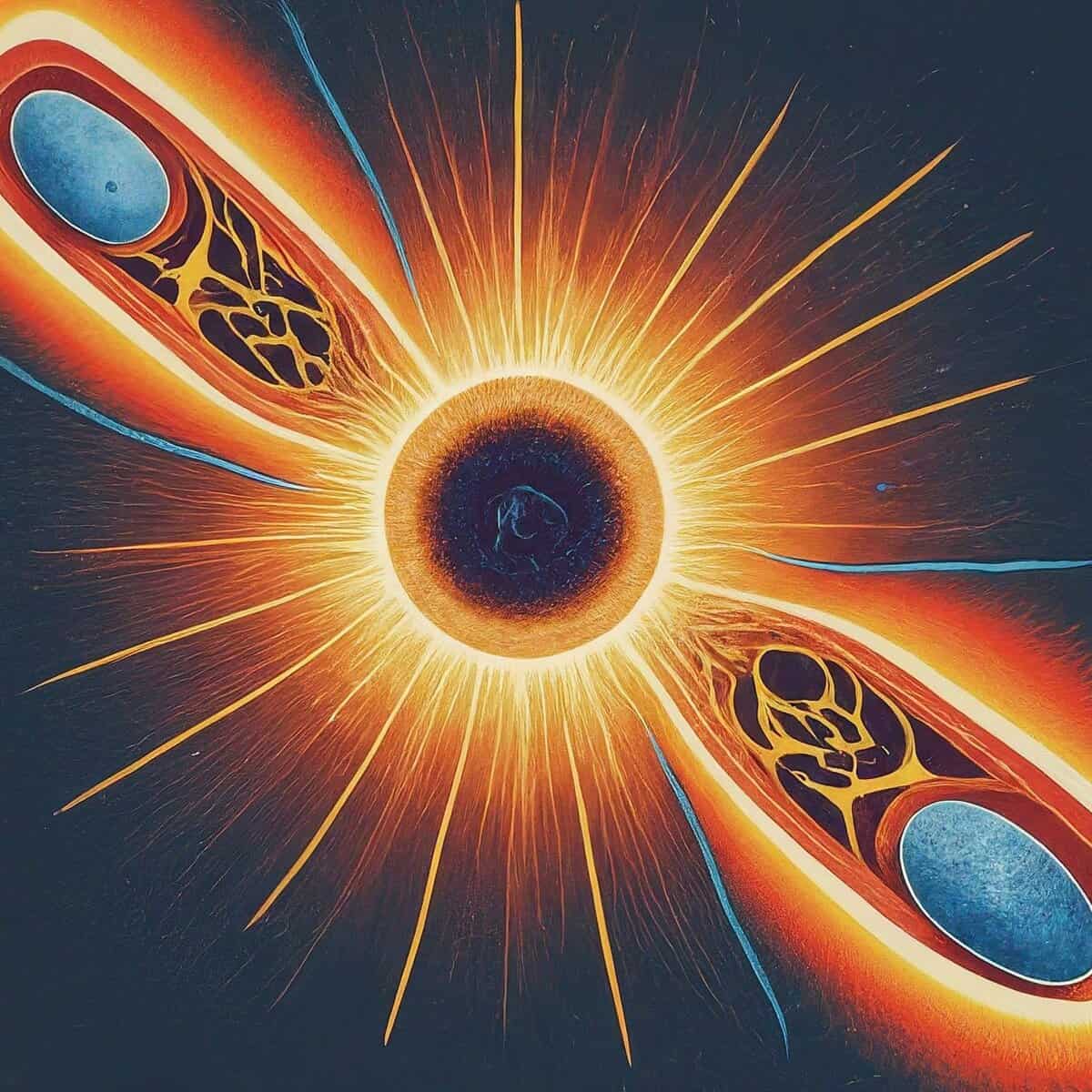
Two main scenarios are being explored. One involves a magnetar interacting with a red giant star, drawing off its mass and triggering a powerful FRB. The other posits that a magnetar ejected matter, creating an FRB along with X-rays and gamma rays, which were subsequently absorbed and re-emitted as infrared light. Both scenarios are plausible, and further research is needed to definitively determine which, if either, is the correct explanation. It’s a cosmic whodunit with high stakes.
Scientific Facts Worth Knowing
- •💡 Fast radio bursts are millisecond-long flashes of radio waves.
- •💡 RBFLOAT is the brightest FRB ever detected, about twice as bright as the previous record holder.
- •💡 RBFLOAT originated 130 million light-years from Earth.
- •💡 The James Webb Space Telescope detected infrared signals from the same region as RBFLOAT.
- •💡 Magnetars are the leading suspects for generating FRBs.



